
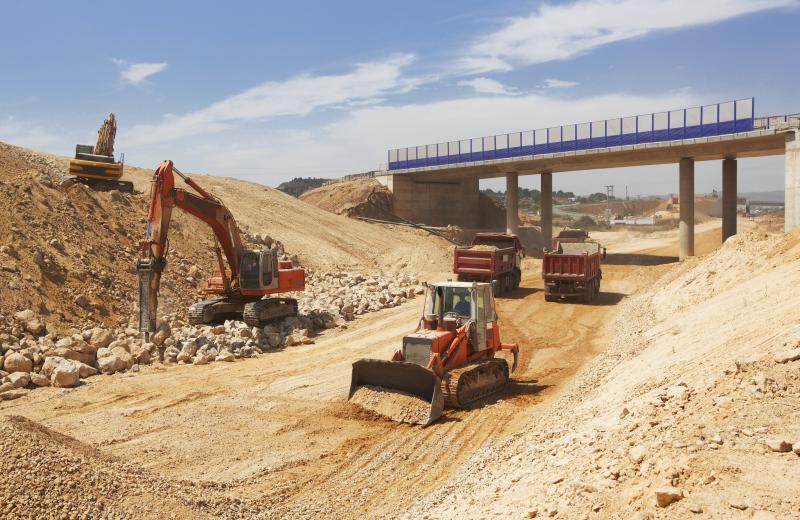
Construction industry in both developed and developing countries is a great contributor and/or a critical component to economic growth and development. As such, it serves as an indicator/litmus-paper for testing the economy of any nation. When there is upsurge in construction, one can easily infer that the economy is booming and vice versa when construction work dwindles. Consequently, construction works are employed by government as a tool for regulating economy.
Construction industry in Nigeria has achieved a great feat not only in the provision of labour and GDP but as well as the ripple effect that emanates from setting up a construction site a particular location, such as market to building/construction materials vendors, work to both skilled/unskilled/casual labourers, and market to local food sellers, to name but a few. For the past few decades, the industry continuously has witnessed tremendous change in design and construction of buildings and other civil works. As ICT accentuates the progress in the industry becomes more noticeable. The building and construction sector in Nigeria registered strong growth, standing at 12.09% in 2010, compared to 11.97% in 2009, reflecting greater investments in both residential and non-residential buildings and other construction activities. Growth in construction related activities rose by 12.24% in 2010 as against 11.97% in 2009 [1]. Construction contribution to the GDP ranges between 3% and 6% from independence to the 80’s before crumbling to about 1% over the last decades [1]. Furthermore, [1] found that the construction sector contribution to the GDP ranged between 3% and 6% since Nigeria gained independence until the 1980s, before decreasing to about 1% since then. While [3] observed an upward progression in the contribution of the construction industry to GDP, which was about 3% in 2012 due to an improved budgetary implementation and private sector participation. According to [4], the sector accounted for 3.44% of real GDP in the fourth quarter 2019, lower than its contribution of 3.48% in the same quarter of the previous year, but higher than the preceding quarter’s 3.01%. In 2019, Construction contributed 3.72% to real GDP. Construction sector grew by 1.31% in Q4 2019 from 2.37% in Q3 2019 and 2.05% in Q4 2018. Construction sector grew by 1.81% in full year 2019 from 2.33% in 2018 and 1% in 2017
Nigeria being a developing country is confronted with a lot of problems and her construction industry is still struggling with a lot of intrinsic challenges, ranging from inadequate technical and managerial know-how to insufficient financial, material and equipment capital base [6]. According to [1] [7] the peculiar problems common to construction industries in sub–Saharan Africa (SSA) countries, are project financing, dearth of technical expertise, corrupt government and poor implementation of policies and programmes; these are challenges mitigating the development and growth of the sector and hence the contribution to the sustainable development. Other problems of local companies revolve around executive capacity and critical mass with technical and financial wherewithal. Generally, most local companies are small, fragmented and incapable of packaging or attracting loans. Few of them can deliver turnkey projects without resorting to some form of partnership agreement for equipment, expertise or technical support
Balouga [7] observed that there exists the so-called “Knowing-Doing gap” in Nigeria, that is the disconnect that exists between policy formulation and policy implementation. This term describes the absence of a critical link between strategy and action. Public policy initiatives and actions in Nigeria have persistently been incapacitated by this gap, with many government programmes and projects ending in downright failure. Inadequate think through, weak institutional capacity, lack of political will to carry through change, inconsistency in government policies, lack of support from relevant stakeholders and corruption are some of the causes of this gap. credit to scirb